
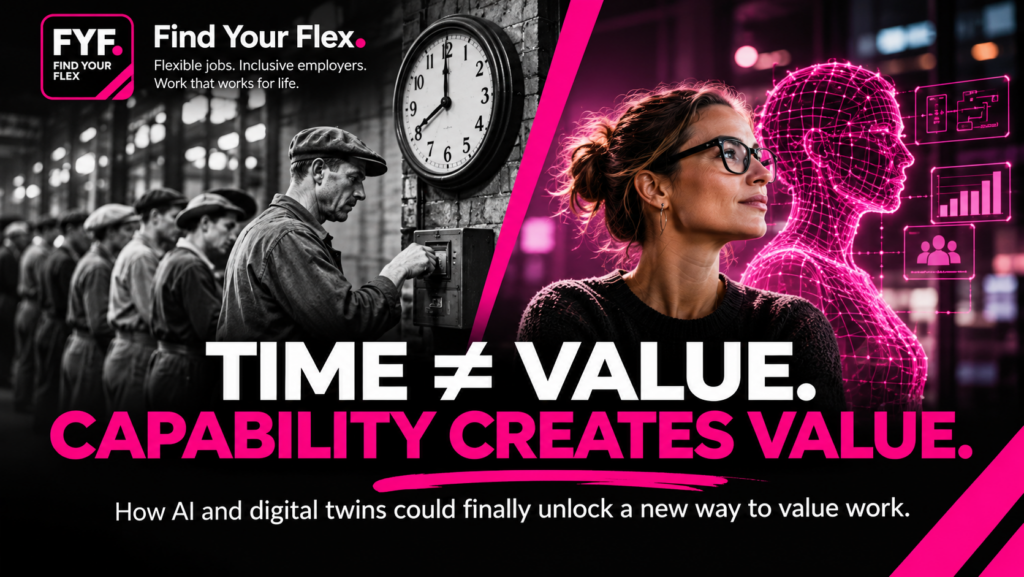
AI, digital twins and the changing world of work could finally challenge one of the biggest assumptions of the Industrial Age: that time is the best measure of human value.
For more than 200 years, we’ve organised employment around a remarkably simple idea.
You give an employer your time.
They give you money.
Eight hours a day. Five days a week. A salary calculated around an agreed number of working hours.
And somewhere along the way, we’ve become so accustomed to this arrangement that we’ve almost stopped questioning it.
But here’s the problem.
Time has never been the same thing as value.
Two people can spend eight hours doing exactly the same job and produce very different outcomes.
Someone might solve a problem in 20 minutes that would take someone else three days.
A brilliant idea could save an organisation millions, yet take only moments to conceive.
And an experienced professional might deliver exceptional results in 25 hours a week, while someone else struggles to achieve the same outcomes in 40.
Yet our employment structures continue to treat time as the primary unit of exchange.
Why?
Because that’s how we designed work during the Industrial Age.
And perhaps, finally, we’re approaching the moment when we can design it differently.
The Industrial Age gave us a system built around time
When work was largely organised around factories, production lines and physical labour, measuring time made practical sense.
People needed to be present.
Machines needed operating.
Production depended on workers being in particular places at particular times.
The relationship between hours worked and output was often relatively visible.
So we developed employment structures around shifts, working weeks, hourly wages and salaried contracts.
Over time, those structures became embedded in how organisations operated.
Even as economies shifted towards services, knowledge work and digital industries, we largely retained the same model.
We changed the nature of the work.
But we didn’t fundamentally change the way we valued it.
Today, millions of people are still employed on the assumption that their contribution should be measured through a contracted number of hours.
And that’s increasingly difficult to reconcile with the way modern work actually happens.
Then along came artificial intelligence
AI is forcing us to confront something we’ve been able to ignore for decades.
A job is not a single activity. It’s a collection of tasks, decisions, responsibilities, relationships and outcomes.
Some of those activities require uniquely human capabilities.
Others are repetitive, predictable or process-driven.
And increasingly, some can be completed, supported or accelerated by AI and other digital technologies.
Think about a recruitment professional.
Their job might involve screening applications, arranging interviews, managing data, advising hiring managers, resolving problems, building relationships and making complex judgements.
Historically, all of those activities have been bundled into one job description, one salary and one working week.
But what happens when AI can support or automate significant parts of that workload?
Does the person suddenly become less valuable?
Or does the value of their contribution shift towards the capabilities that matter most?
Their judgement.
Their creativity.
Their ability to navigate complexity.
Their emotional intelligence.
Their capacity to build trust and make better decisions.
AI doesn’t simply change how quickly work gets done. It changes what we need humans to do.
And that creates an extraordinary opportunity to rethink how we value human contribution.
Digital twins could take this even further
This is where things become particularly interesting.
A digital twin is a digital representation of something in the real world, traditionally used to model, monitor or simulate physical systems and processes.
But the concept is evolving.
Imagine an organisation that can create a digital representation of how work actually happens.
Not just an organisational chart.
Not just a collection of job descriptions.
But a living picture of the activities, capabilities, decisions, dependencies and outcomes that make the business function.
Imagine being able to see which tasks are best performed by people, which can be supported by AI and which can be automated.
Imagine being able to simulate different ways of organising work before making changes.
And imagine understanding the capabilities an organisation needs without automatically assuming they must be packaged into traditional full-time jobs.
This is the potential of combining AI with digital twins of work.
Not replacing people with digital copies of themselves.
But creating a much clearer understanding of how human and digital capabilities can work together.
And once we can see work differently, we can begin to value it differently.
What happens when a 40-hour job no longer takes 40 hours?
Let’s imagine a professional who is employed for 40 hours a week.
They are experienced, capable and consistently deliver excellent results.
Now imagine that AI removes 15 hours of repetitive administration, reporting and routine processing from their workload.
The organisation still needs their expertise.
It still needs their judgement.
It still needs their ability to solve problems, manage relationships and make decisions.
But it no longer needs them to spend 40 hours completing the same collection of tasks.
So what happens next?
Does the employer give them another 15 hours of work?
Does it reduce their salary?
Does it make the role redundant?
Or does it recognise that the person can now deliver the same, or potentially greater, value in less time?
That question sits at the heart of one of the biggest challenges facing the future of employment.
If technology reduces the time required to create value, who benefits from the time saved?
The employer?
The employee?
The customer?
Or could we design a model in which the benefits are shared?
There isn’t one simple answer.
But we need to start asking the question.
From buying time to buying capability
For decades, employers have largely bought access to people’s time.
They recruit someone into a role, agree a salary and expect them to work a defined number of hours.
But what if the starting point became capability instead?
What does this organisation need to achieve?
What human capabilities are required to deliver those outcomes?
What work can technology undertake?
And how should the human contribution be valued?
This could create a very different relationship between employers and employees.
One where an experienced professional isn’t automatically worth less because they work three days rather than five.
One where career progression isn’t dependent on being available for longer hours.
One where people are recognised for the quality, complexity and impact of their contribution.
And one where organisations can access the capabilities they need without assuming that every requirement must translate into another conventional full-time role.
This doesn’t mean every job should become freelance or every worker should be paid by the task.
Far from it.
Employment provides important protections, stability and security that must not be lost.
But it does mean questioning whether contracted hours should remain the dominant way we organise and reward human contribution.
Could this finally unlock genuine flexible working?
Here’s why this matters so much to us at Find Your Flex.
For years, flexible working has largely been about negotiating changes to an existing employment model.
A shorter working week.
Different start and finish times.
Working from home.
Job sharing.
And while all of those arrangements can make an enormous difference to people’s lives, they often leave the underlying structure of work untouched.
We’re still trying to fit flexibility into jobs designed around time.
But imagine a different approach.
Imagine employers designing work around outcomes, capabilities and genuine operational requirements from the beginning.
Imagine someone being able to contribute their expertise for 20 hours a week without automatically being viewed as half as valuable as a full-time colleague.
Imagine parents, carers, people with disabilities, experienced professionals and those returning to employment having access to meaningful careers that recognise what they can contribute, rather than simply how many hours they can offer.
Imagine flexible working no longer being something people have to ask permission for.
What if flexibility became a natural consequence of designing work around value instead of time?
That could be genuinely transformative.
But there’s a catch. We have to design this future deliberately.
Technology alone won’t create a fairer working world.
In fact, without thoughtful leadership, AI could simply make existing problems worse.
Organisations could use automation to demand greater output from fewer people.
They could use digital monitoring to measure every minute of someone’s working day.
They could reduce working hours without protecting earnings.
Or they could create new forms of insecurity by turning employment into a series of disconnected tasks.
That’s not the future we’re advocating.
The opportunity is to use technology to create better work, not simply cheaper work.
That means involving employees in redesigning roles.
It means protecting fair pay, employment rights and career development.
It means recognising that some forms of human contribution, particularly care, trust, creativity and judgement, cannot be adequately measured through simple productivity metrics.
And it means understanding that the value of human capability isn’t always immediately visible in a spreadsheet.
A capability-based approach must be fair, transparent and evidence-led.
Otherwise, we risk replacing one flawed measurement system with another.
Welcome to the age of FusionWork™
At Bloor Research, the concept of FusionWork™ explores a future in which human and digital labour are deliberately designed to operate together.
Rather than simply introducing AI into existing jobs, the opportunity is to reconsider how work is structured in the first place.
Which activities should be automated?
Where should people be augmented by technology?
Which outcomes depend on human capabilities?
And how do we create operating models that can adapt as technology and human capability evolve?
These are no longer theoretical questions.
They are becoming increasingly important decisions for employers across every sector.
And they have profound implications for the way we recruit, develop, reward and retain people.
Because once we stop assuming that a job must equal a fixed number of hours, we open the door to entirely new possibilities.
Perhaps the biggest opportunity isn’t artificial intelligence. It’s human potential.
We’ve spent generations building employment systems around the time people can give.
Now we have an opportunity to build them around the capabilities people bring.
That doesn’t mean time becomes irrelevant.
Some work will always require presence, availability and continuity.
And fair reward must still reflect effort, responsibility, risk and the realities of different industries.
But time no longer needs to be our default proxy for value in every role.
AI and digital twins could help us understand work with a level of detail that simply wasn’t possible before.
They could help employers design roles more intelligently.
They could help people contribute in ways that better reflect their strengths.
And they could help us move towards a world where flexibility, productivity and human potential are no longer treated as competing priorities.
The Industrial Age taught us to buy people’s time.
The next age of work could teach us to value their capability.
And perhaps that’s when flexible working finally stops being a benefit and becomes something much more powerful.
A better way of working.
Find Your Flex. Work that fits your life.
Ready to rethink work?
Looking for a job that values what you bring?
Explore flexible, hybrid, remote and part-time opportunities at Find Your Flex Jobs.
An employer ready to work differently?
Discover how Find Your Flex can help you reach talented people and rethink how you attract and retain the capabilities your organisation needs.